
Le Kalimanthrope
Pluridisciplinary research group upon Kalimantan


Field notes by Luc-Henri Fage / CAVE N° 01 GUA MARDUA
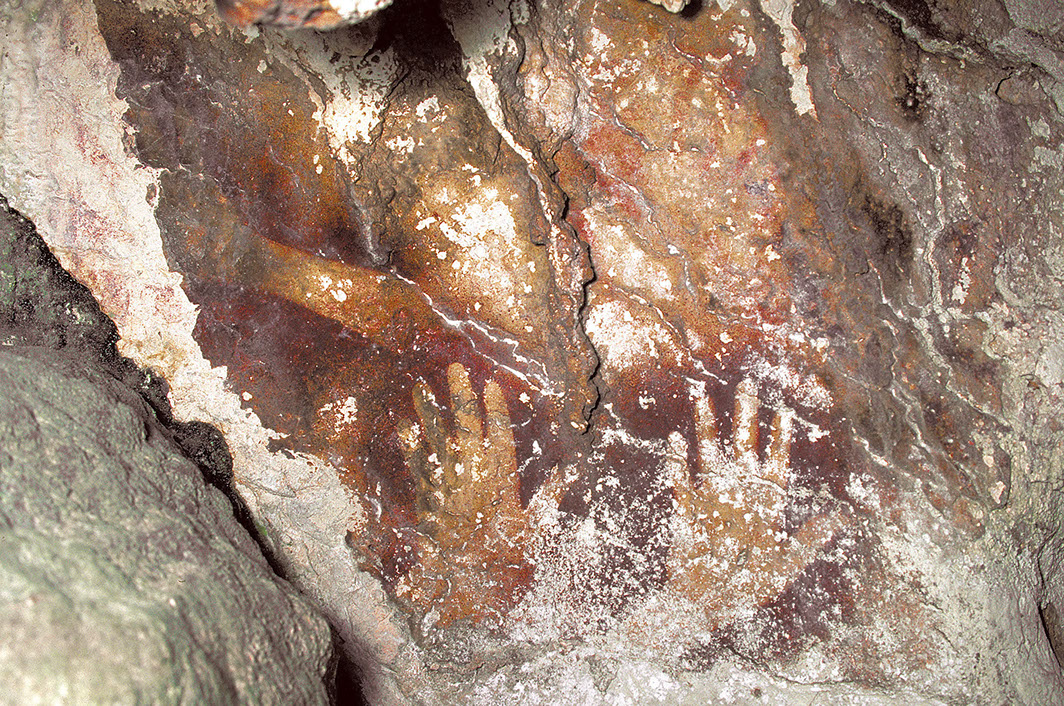
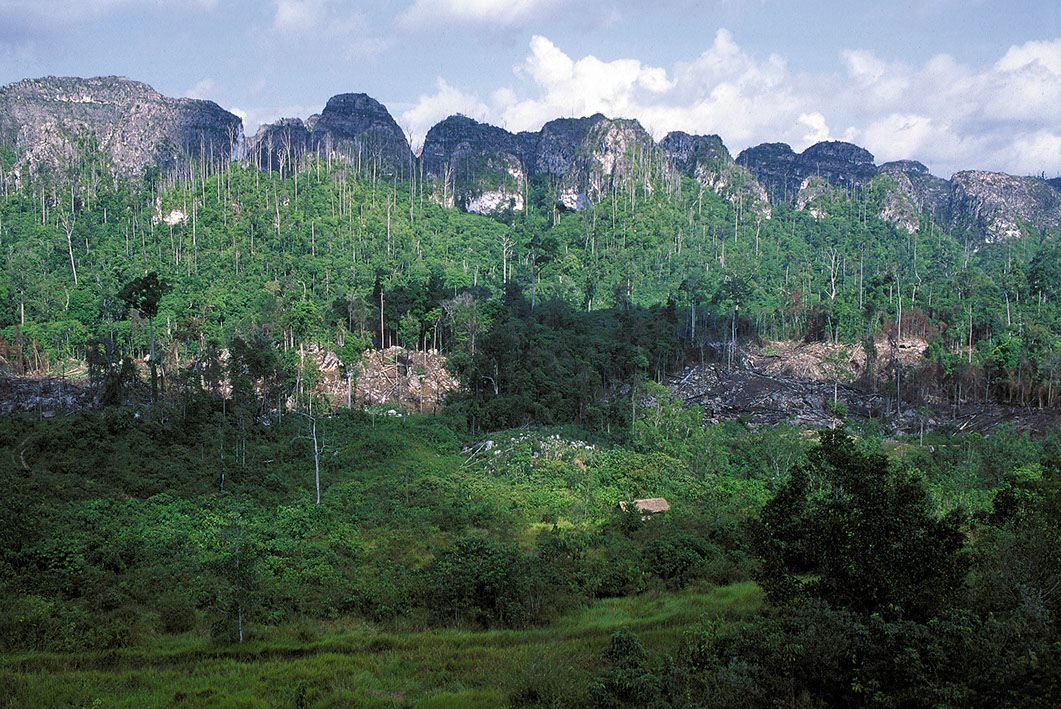
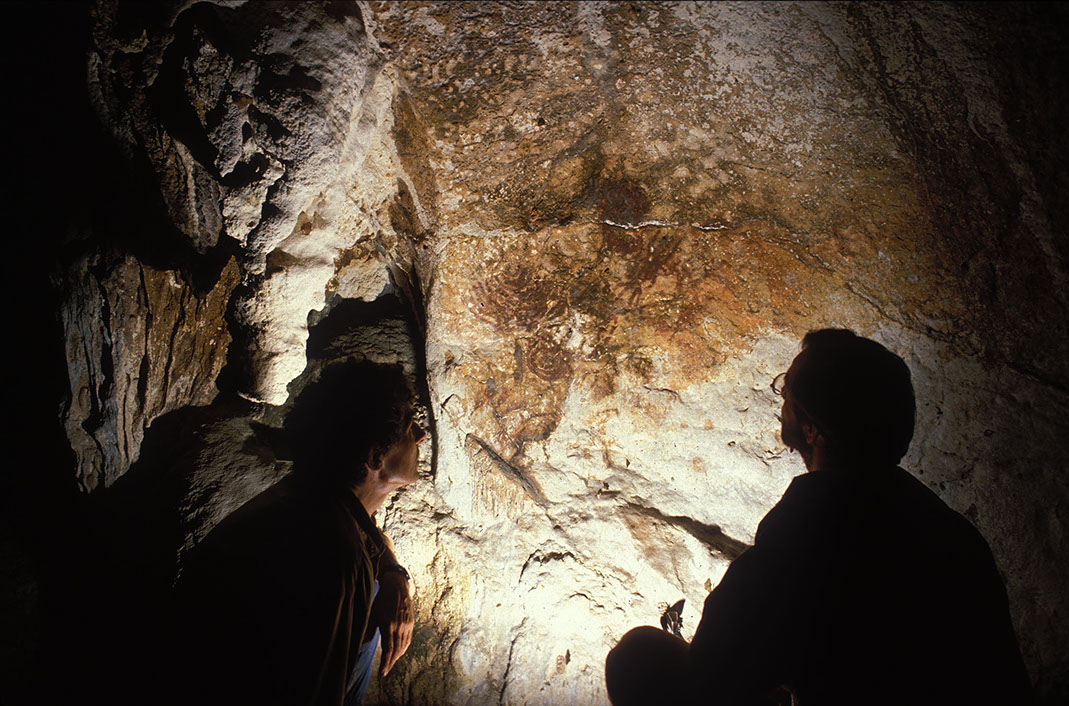
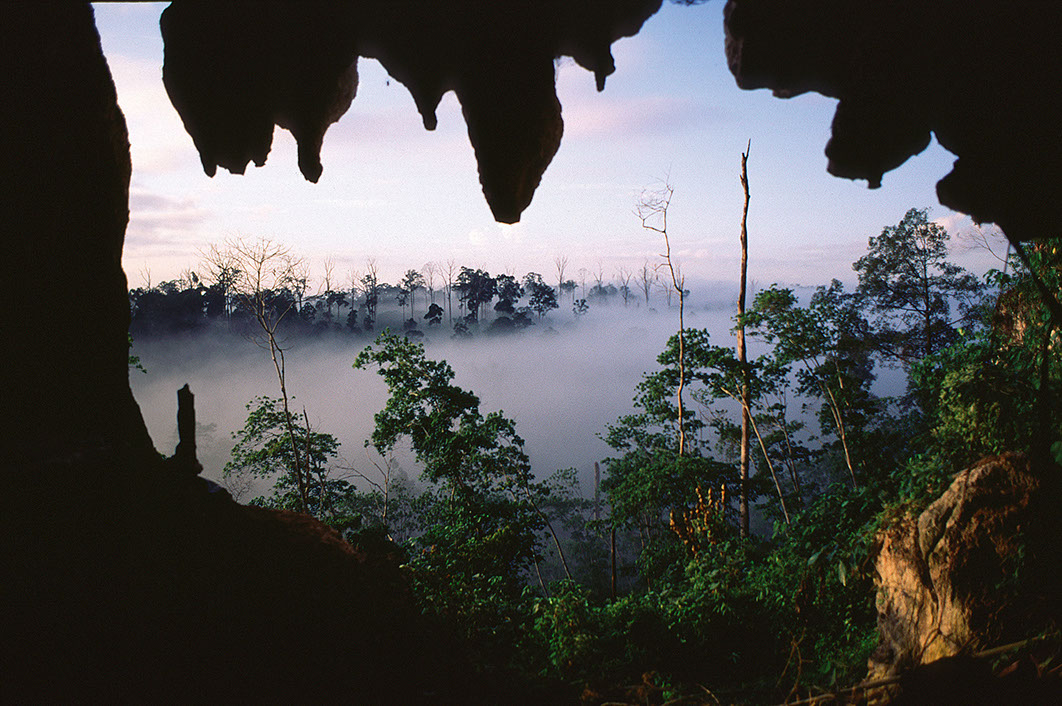
The first paintings discovered in Borneo: four negative hands...
The small Pengadan karst is nonetheless an impressive series of tropical karst peaks.
August 1994, two happy inventors... with questions.
Gua Mardua dominates the early morning mist.
1 - 4
<
>
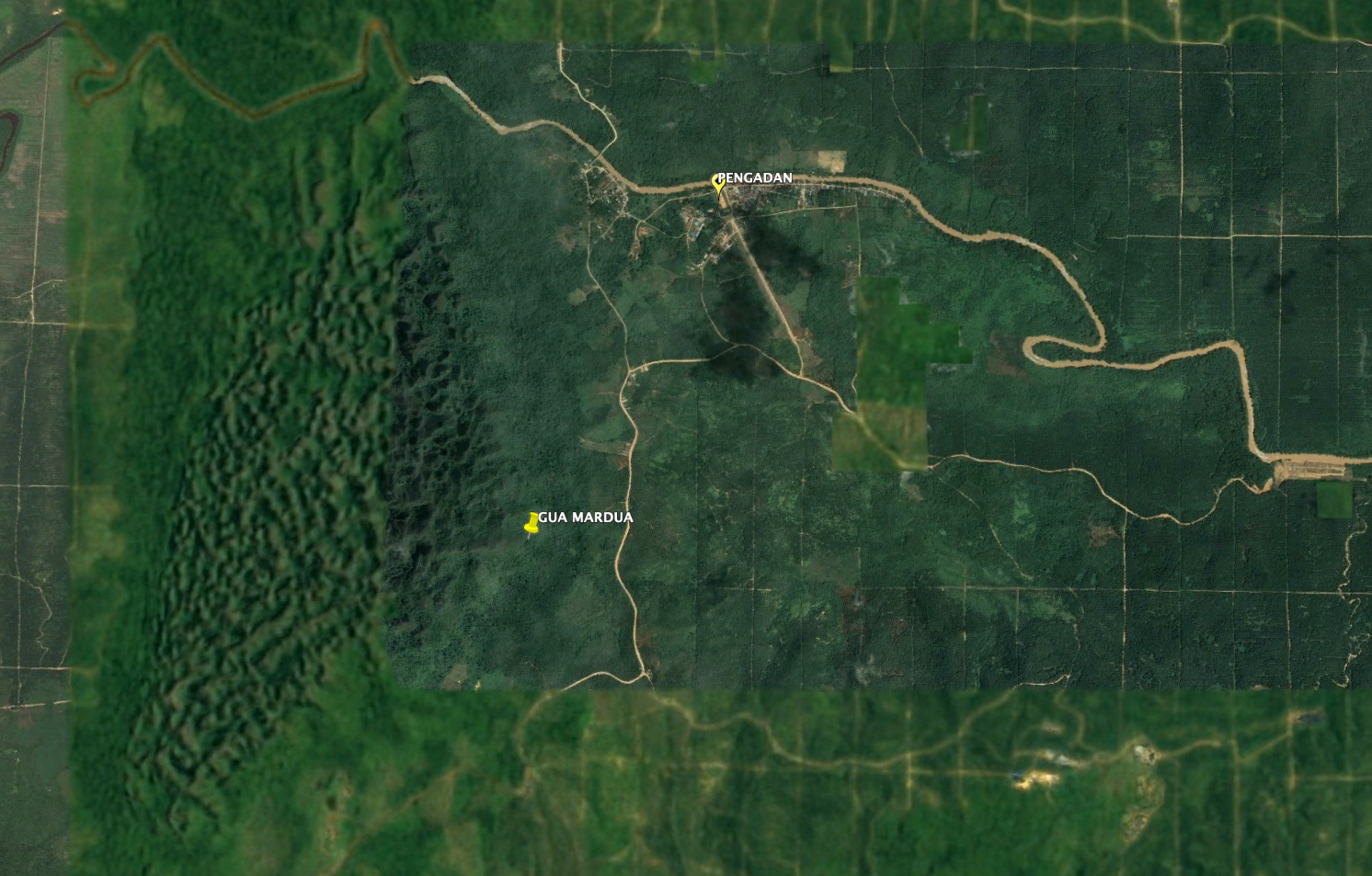
Location of Gua Mardua and the village of Pengadan (click to enlarge)
Gua Mardua (or Gua Kilo Dua)
Discovered on August 20, 1994, the cave was studied in greater depth the following year during the 1995 mission.
GPS coordinates
1° 13,945’ N – 117° 44,341’ E – Z = 135 (1994)
Team
Guide : Agus
August 20 to 23 1994 : Jean-Michel Chazine, Luc-Henri Fage
August 1995 : same team, plus Pindi Setiawan and Tanguy Thuaud (cameraman)
Toponymy
Gua Mardua : cave with two entrances (Dayak name) or Kilo Dua: cave at kilometer 2.
Access
On the Pengadan territory, above the coastal river of the same name. A karst massif cut by the river offers a landscape of impressive peaks. Other caves have been sighted in the area: Gua Ampanadas, Gua sans nom, etc.
At Kilometer 2 on the forest road, the road runs along the top of an oval depression, used by gardens, bordered to the west by the karstic cliff. The porch was visible from the road (since the forest on the karst has grown back).
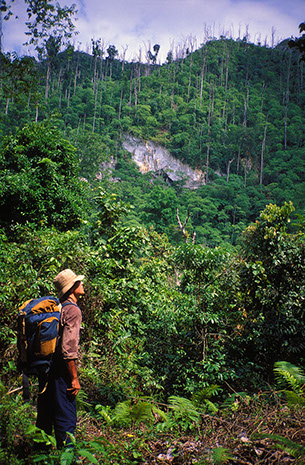
Jean-Michel at the trailhead to the cave (at km2 on the road)
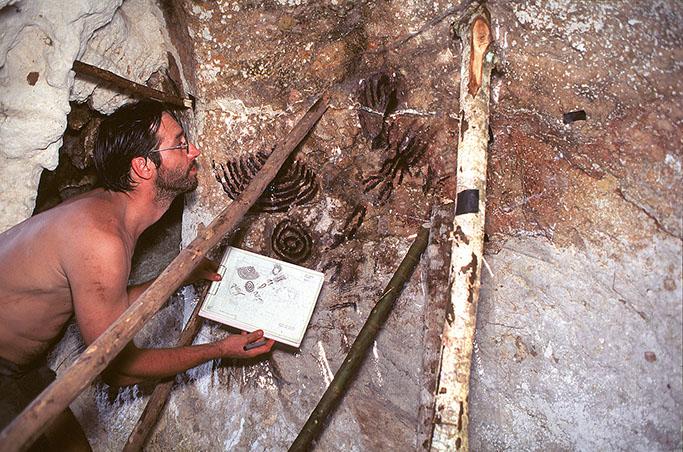
Luc-Henri in front of the composition of Group 3, overhead and reading sketch.
Discovery
Eight days before our departure for the Mangkalihat peninsula, with the reports of the French caving expeditions of 1982, 1983 and 1986 in our luggage, Arnoult Seveau tells me he remembers seeing charcoal drawings in an easily accessible cave, Gua Kilo Dua, near Pengadan, “a bit like the ones you found at Liang Kaung”, he says. Kilo Dua means “kilometer 2” on the forest trail, and so we set off along a magnificent tropical karst, made up of a series of karst peaks stacked one on top of the other, whose base is reached by a steep 70° slope.
At the entrance, it's hard not to see the graffiti in this cave with two entrances (hence the name Gua Mardua), overlooking the Pengadan plain, the forest (well destroyed by foresters and the 1982-83 fire), and to the far west, the shores of the Makassar Strait and the Mangkalihat cape! Between two names and three contemporary dates, however, appear a number of “archaic” drawings that startle me: sun wheels, anthropomorphs and boats, both sailing and steam-powered... as well as animals.
It's reminiscent of both Niah's funerary “boats” and Liang Kaung's archaic drawings. The “underground” part seems of little interest, frequented by swallow-nest hunters. On our way out, while Jean-Michel is busy scratching the powdery surface layer, reworked by animals and humans, to unearth flints and ceramic shards, I notice concentric orange shapes four metres up, which I initially take to be the remains of a mason wasp's nest. As I got closer, I realized that they were red chalk drawings!
Jumping onto a large fallen boulder cluttering up the center of the cave, I find myself face to face with two negative hands! A glance to the right already shows me other paintings, but already I'm shouting with joy, to call Jean-Michel, stunned by the discovery, which he thought impossible in Borneo...
Together, we continue our discovery, including a frieze of negative hands, a kind of lizard... Some twenty hands are inventoried. These were the first hands found on the whole island of Borneo!
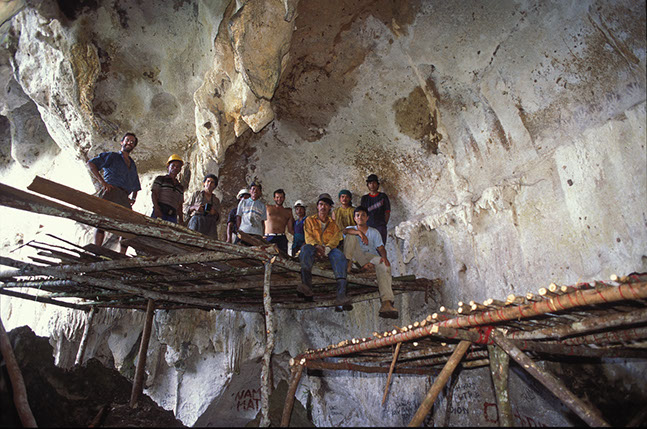
The following year, we had a vast platform built to facilitate the study. In all, at least 49 negative hands were inventoried, many of them badly degraded by the erosion attacking the limestone layer.
The 1995 team on the platform built to study the paintings above.
Description
The entrance hall (large under-rock shelter) measures 200 m2 and has two entrances-one very large to the south-east, the other narrow and overlooking a cliff to the north-east. The floor is relatively flat, cluttered with boulders and concretions. The ceiling is often at 6/7 m, with a high point in a bell above the paintings. With its concretion pendants, creepers and forest views, it's a subterranean landscape well worth visiting. Two dark galleries: one leads to the east gallery, through an impassable narrow passage cut into a large concretion; the other, which goes deeper into the mountain, leads to a large underground room, used by nest hunters, from which a gallery starts, quickly blocked by concretions. A “real” cave opens below, on the access path to the main porch, through a fault in the rock, and leads to an underground network of perhaps 500 m, with alternating large chambers and significant clay fillings, and galleries, featuring astonishing concretions and a wealth of animal life!
We returned for ten days in 1995, in the company of Pindi Setiawan, whom Jean-Michel had met through Dr Ko, president of the Indonesian caving federation. A young independent researcher with a passion for his country's rock art, he discovered Borneo's forests and caves with us... He was the perfect companion for all our adventures until 2003.
Cave art
1: Charcoal drawings :
They tend to occupy the lower part of the walls, between ground level and 2-3 metres. They are all created by rubbing charcoal on limestone, stripped by erosion, i.e. without the layer of calcite deposited by underground water at the end of the creation of the flooded galleries. This obviously gives them a much more recent age than the ochre paintings, which are all on calcite. Peeling away the calcite exposes the rock.
They can be classified into several families:
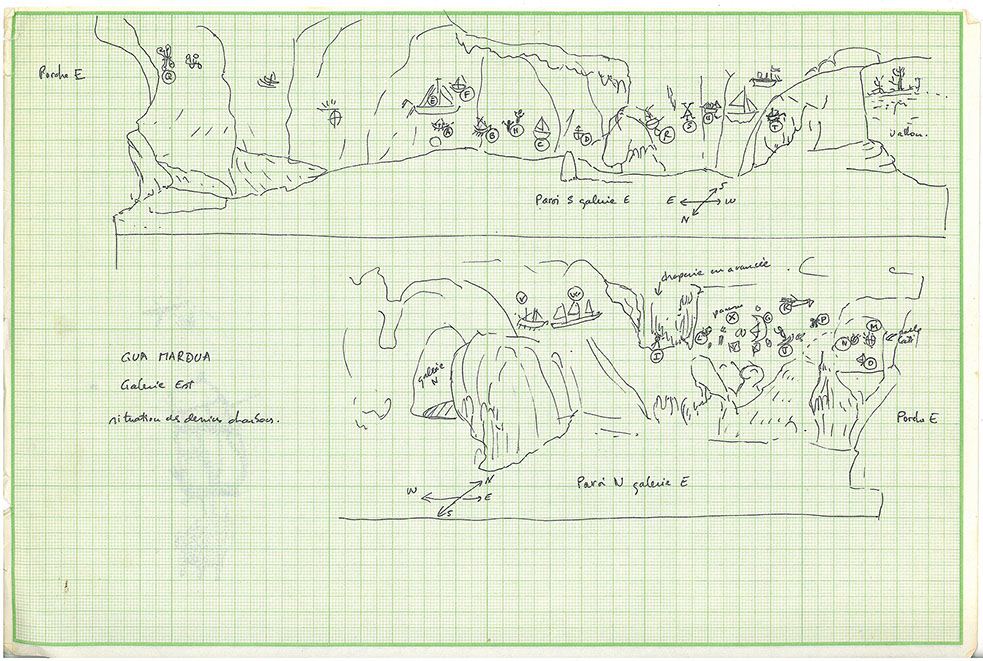
A - boats: at least 12 have been recorded, and their forms range from the simple, stylized pirogue (a crescent-shaped boat with a mast and props), and sometimes with crews busy paddling... to the “Western” three-master, or even the 19th-century steam boat.
This “art of contact” marks the encounter between the ancient inhabitants of Borneo and the first European navigators (who approached the eastern coasts around the 16th century).
Also recognizable are the Bugis boats, originally from the neighboring island of Sulawesi, which still trade with the region's ports today.
Detailed observation of the drawings suggests that they were made by different people, and even over quite a long period of time, with the “simplest” appearing to be the oldest. Unfortunately, they are now soiled by an incredible quantity of modern graffiti, visitors' names, obscene drawings, the result of swallow-nest pickers...
Figure 1 - General survey of the drawings on the two opposite walls of the east gallery. Letters refer to individual drawings.
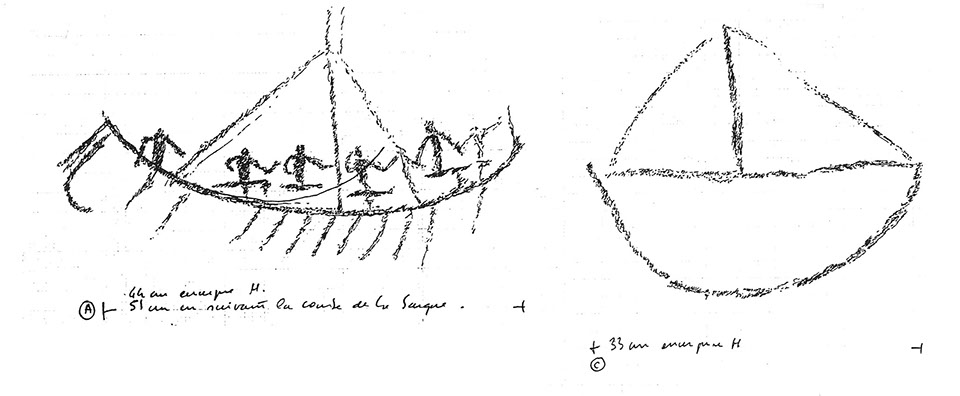
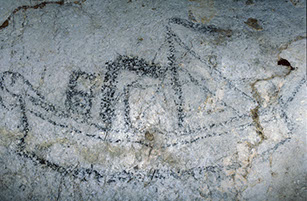
Figure 2 - Survey of two types of sea “pirogue” (A), with oarsmen and a mast, on the left, or very stylized... on the right (C).
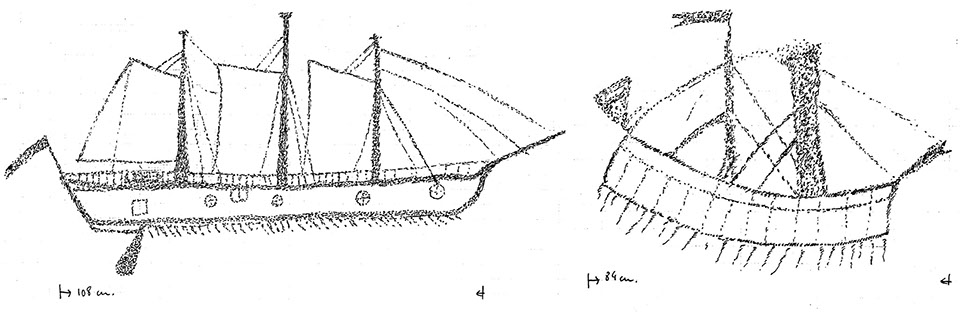
Figure 3 - two “modern” boats, a three-master (W) with hatches, railing and flag, and a mixed sail/steam boat (V)...
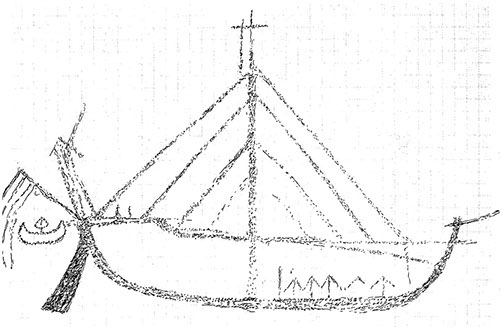
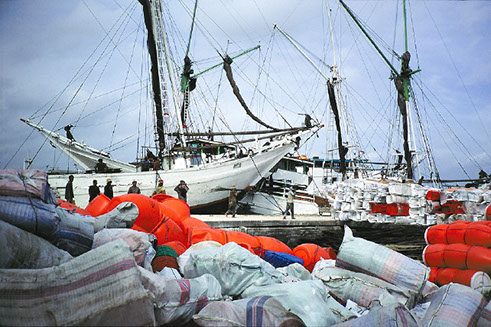
Figure 4 - Typical Bugis boat (E), with central mast and oar-shaped rudders. Note the anthropomorphic silhouettes at the bottom of the bilge,
giving it its full dimension... Right, Bugis boat in Samarinda harbor, 1994.
Figure 5 - Composition of some drawings associating anthropomorphs (extension
of 0.83 m).
B - Anthropomorphs
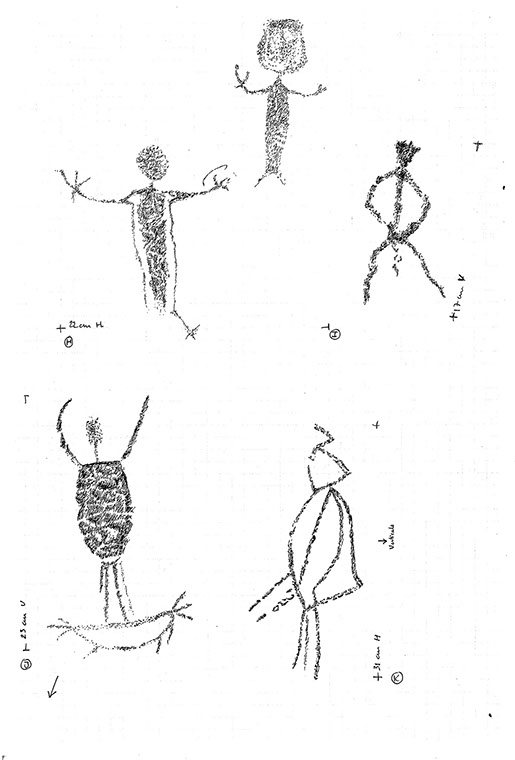
At least 8 anthropomorphs have been counted.
One shows a man appearing to walk on the back of a possibly animal form (fig. 7); two others are presented upside down and could evoke the symbolic representation of the bat as found on Asmat shields (West Papua), fig. 6.
They can be highly stylized, even enigmatic, or feature details such as fingers. They are often associated with other symbols in what may look like a composition. See figure 5.
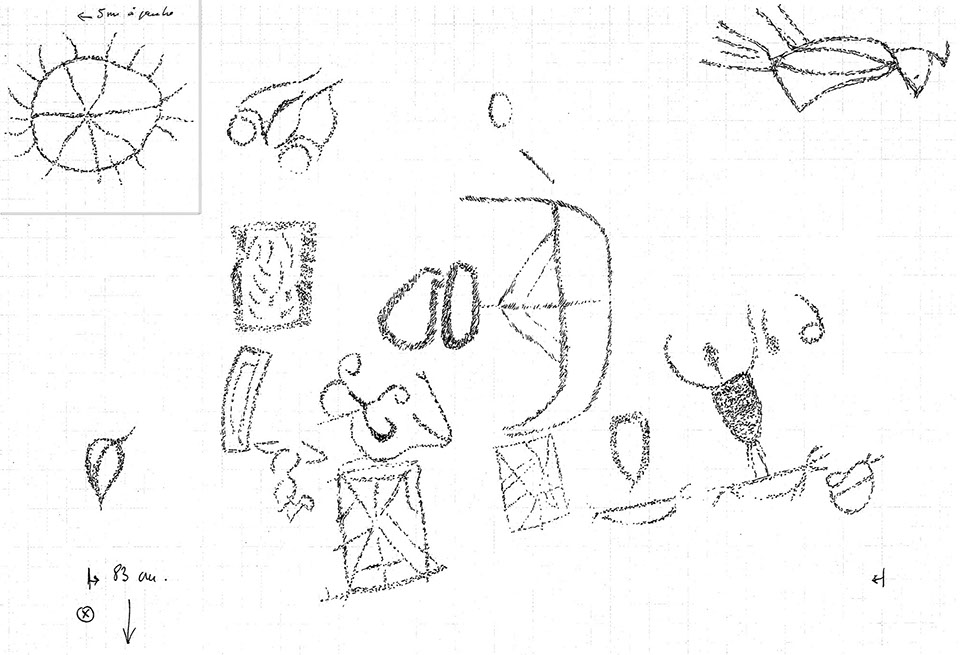
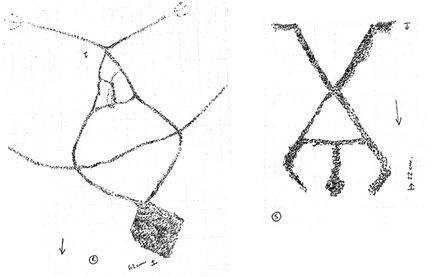
Figure 6 - Anthropomorphic figures, head down, similar to the stylized bats on Asmat shields (Papua).
Figure 7 - Some Gua Mardua anthropomorphs.
C - Solar wheels and other geometric designs
These universal motifs are very often associated with proto-dayak designs (see fig.3) in the form of arabesques, foliage, and even a very pretty stylized “butterfly”...
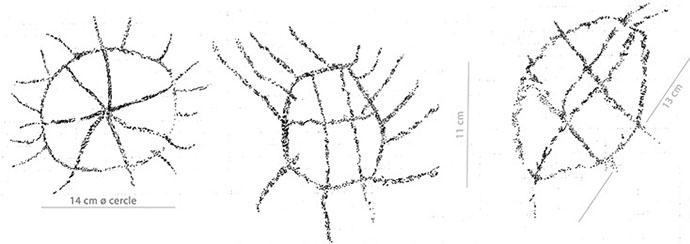
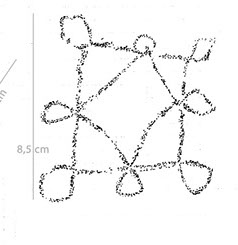
Figure 8 - Series of “sun wheels” (L and M) and other geometric shapes (N and P).
Figure 9 - Proto-dayak arabesque “butterfly” (Q)
2 – Paintings
G1
G7
G2
G2
G8
G3
G3
G4
G5
G5
G6
G6
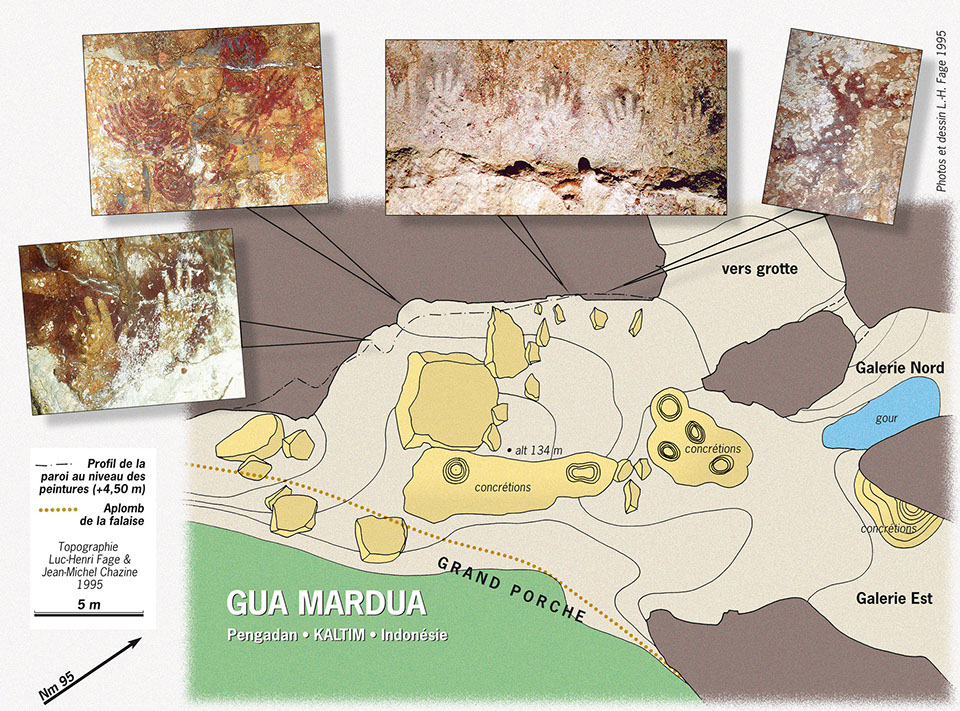
Figure 10 - Plan of the Gua Mardua porch, with groups of rock paintings indicated. The letters refer to the different painting “groups” used in this text.
Color of Gua Mardua's various ochre paints :
Group 2
- almost violet ochre/garnet
- spray paint
Group 3
- same ochre, for symbolic drawings: Y100-M100-C40
- hands more or less erased on the right: redder Y100-M100-C20
Group 4
- brighter ochre (projection), visible droplets, gradations often in the direction of the projecton hemisphere from the palm.
Group 5
- highly degraded projection, ochre turns black (superimposition of calcite and moss): Y100-M100-C60
- interdigital space, the paint has protected the calcite layer underneath
- calcite on 3rd hand.
They are obviously much harder to find than charcoal, as they are almost all located between 3 m from the ground and the top of the gallery, in darker areas (which probably explains their survival). That's why two French caving expeditions, in 1982 and 1986, came to explore the dark gallery without seeing them in the porch.
Our aim being different, our interest in the charcoal drawings led us to more or less consciously inspect the cave walls. But once we'd seen a painting, and as our eyes got used to them over the course of our observation sessions, their number increased. From the 20 hands counted on the day of the discovery, we now have almost 50 hands (or remnants of hands).
The study on a platform and with wooden ladders made on site enabled us to realize that, at the time when the paintings were made, they must probably have covered the entire wall... It was the peeling off of the calcite layer serving as a support for the paintings that caused their destruction. In some cases, a layer of ochre helped protect the calcite. In the case of the negative hands, produced (with the exception of two, visibly retouched by the application of ochre) by spraying coloured pigment, the liquid pigment penetrated deep into the structure of the limestone, leaving a very faded trace.
The study also revealed that Gua Mardua contained virtually all the motifs found elsewhere in the caves: negative hands, hands overloaded with motifs, aligned hands, geometric shapes and anthropomorphic figures. Only the animal representations (deer), which are common elsewhere, are missing... except for one strange “animal” (G9).
The slope of the wall seems to have played a role in the conservation of the paintings: the sloping parts are less attacked than the others, where condensation must be more effective. Water and light, with their host of bacteria, are the primary destroyers of paint and underlying calcite.
Group 1: 6 negative hands: 1 left, 1 right and 4 traces of hands, very high up.
Group 2: 4 negative hands: 1 D and 2G, plus a very light D, plus an “arachnoid”, which was later revealed (in 2001) to be... anthropomorphic. The left hand was partly destroyed by a run-off at the bottom of the dihedral. 5 m above ground (Fig. 11)
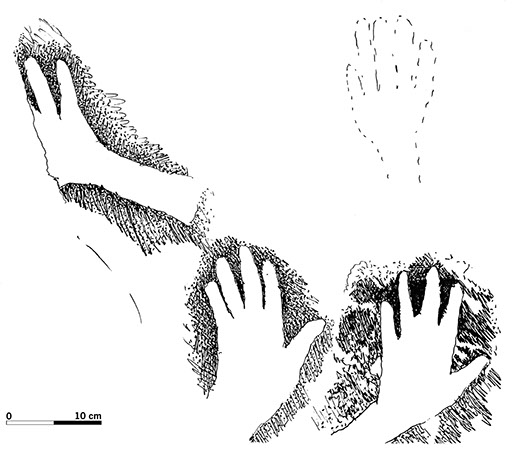
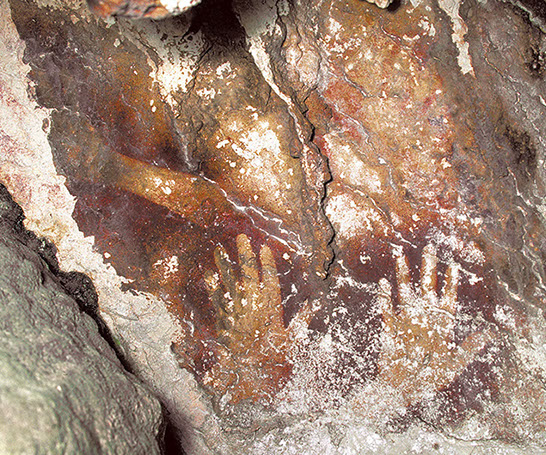
Figure 11 - Group 2 with its four hands, the anthropomorph was only understood as such after the discovery of Gua Tamrin.
Group 3 :
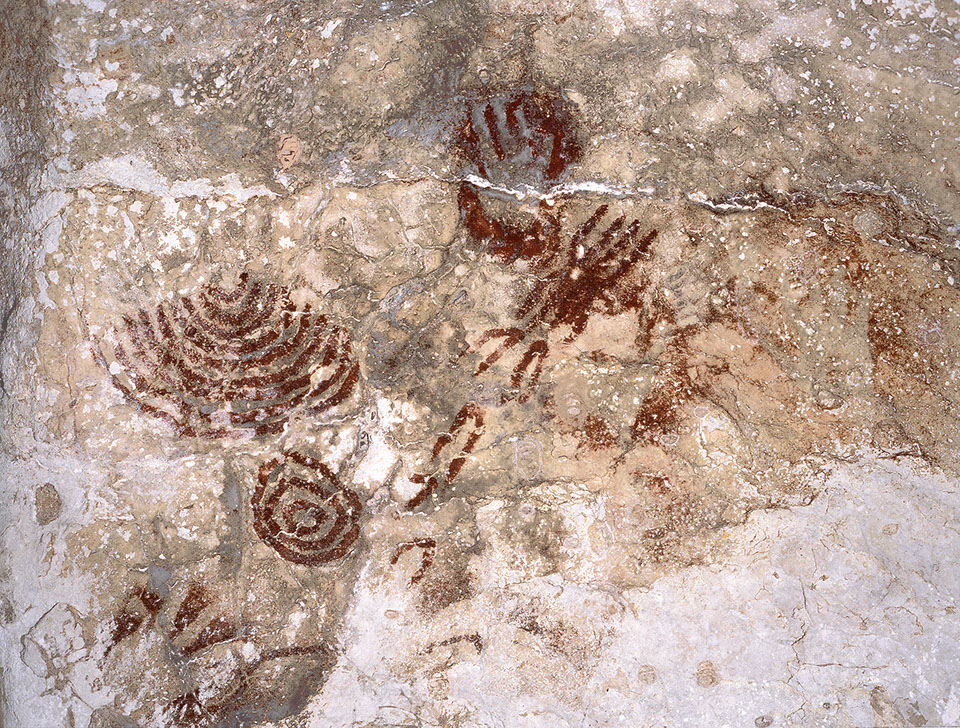
Figure 12 - Group 3 with Photoshop colors. Bottom right, freehand drawing, below detail of G3 hand.
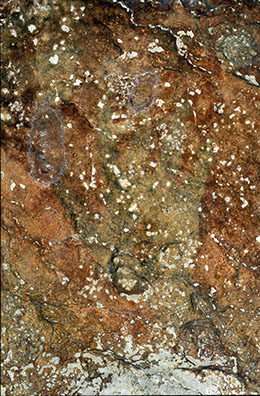
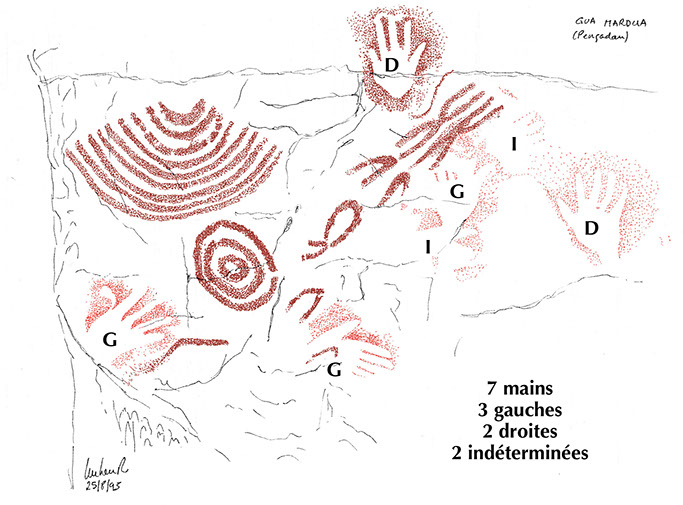
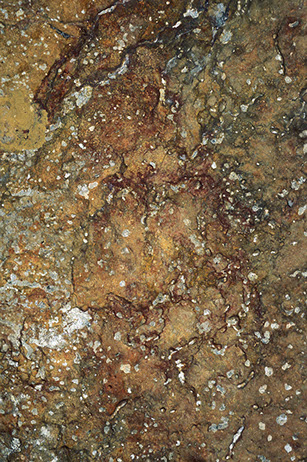
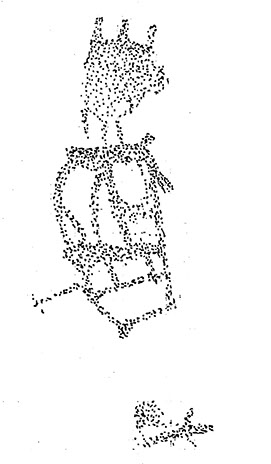
This is a complex composition, comprising :
- 6 negative hands, including one retouched with paste pigment to close the palm at the bottom, one with a twisted thumb (displacement during painting? bone deformity?), and one with a “notch
- series of 9 concentric arcs, candelabra-style
- three concentric ovals
- an anthropomorphic “spider”?
This composition is not accidental, but reminiscent of the work of Australian Aboriginal painters. The lower part has suffered from erosion. On the right, almost invisible, we find a strange anthropomorph, which was difficult to draw and even more difficult to photograph!
A small, barely visible anthropomorph...
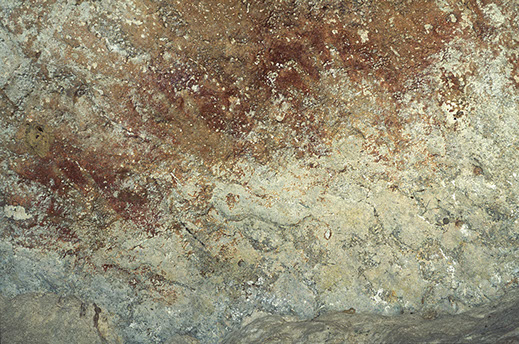
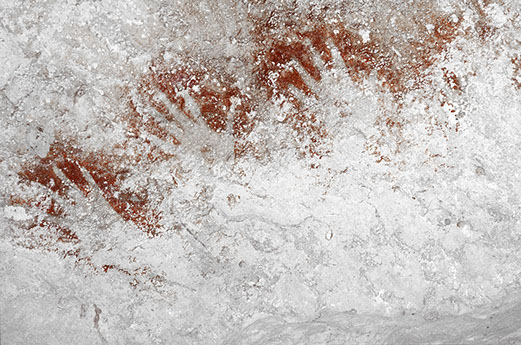
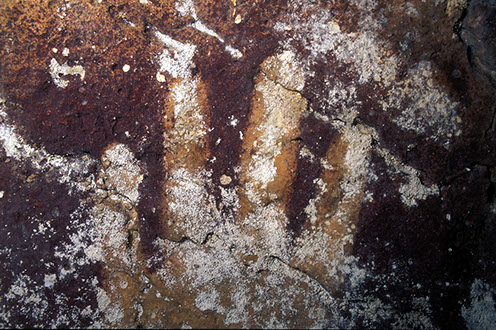
Photo 4 - Group 4, right-hand section: 1 right hand, two left hands (also overpainted with check marks) and one very effaced hand. Note two lines that may have connected hands, as in Gua Tewet (photo processed in Photoshop).
Group 4: this zone comprises the paintings between group 3 and the frieze of hands in group 5. It has suffered a great deal from erosion, and the hands are difficult to discern. On the left, there would be 4 hands (including 1D and 3G), and on the right 4 hands (including 2G, 1D and ID in trace), the two left hands being overpainted with ticks.
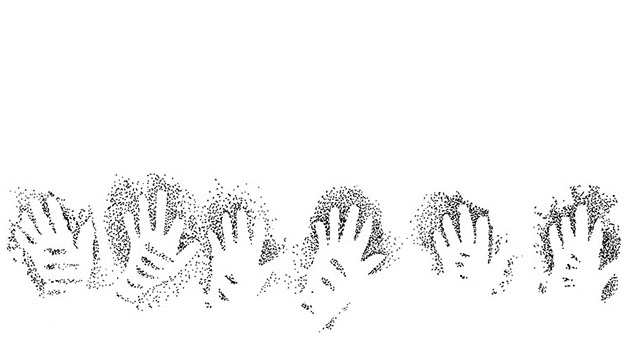
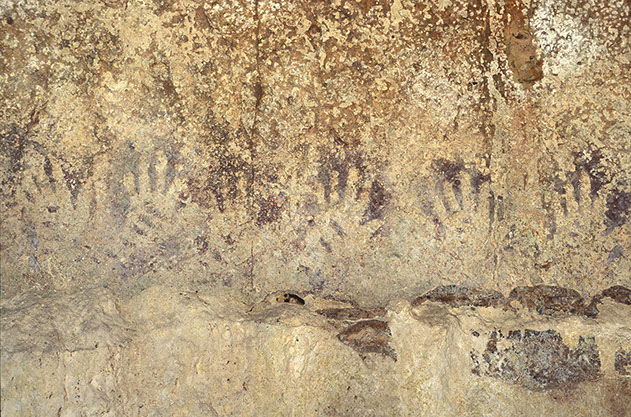
Figure14 - The frieze of six decorated hands, photo and drawing
Group 5: this is the beautiful frieze of hands lined up at 3.50 m high, i.e. 6 left hands and a trace. The six hands, which appear to be the same hand, are overpainted with coches. The erosion on both sides suggests that it was longer, and probably connected to the three fan-shaped hands below the “lizard”. J.-M. Chazine's first interpretation of the coches was that they had crossed hands. We had to wait for the discovery of Gua Tewet to see this particularity of Borneo rock art.
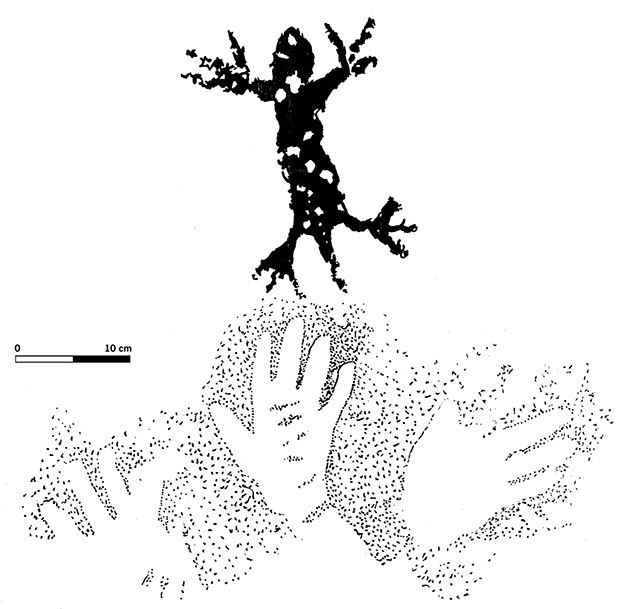
Group 6: 3 right negative hands overpainted with ticks, fanned out under a lizard reminiscent of the flying lizard of Borneo...
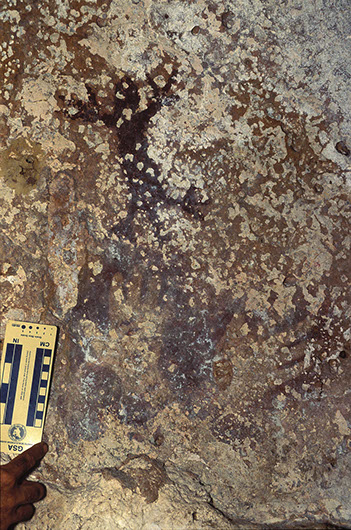
figure 15 - The hieratic “flying lizard”, in majesty above three fan-shaped hands (group 6). View on the left and photo on the right.
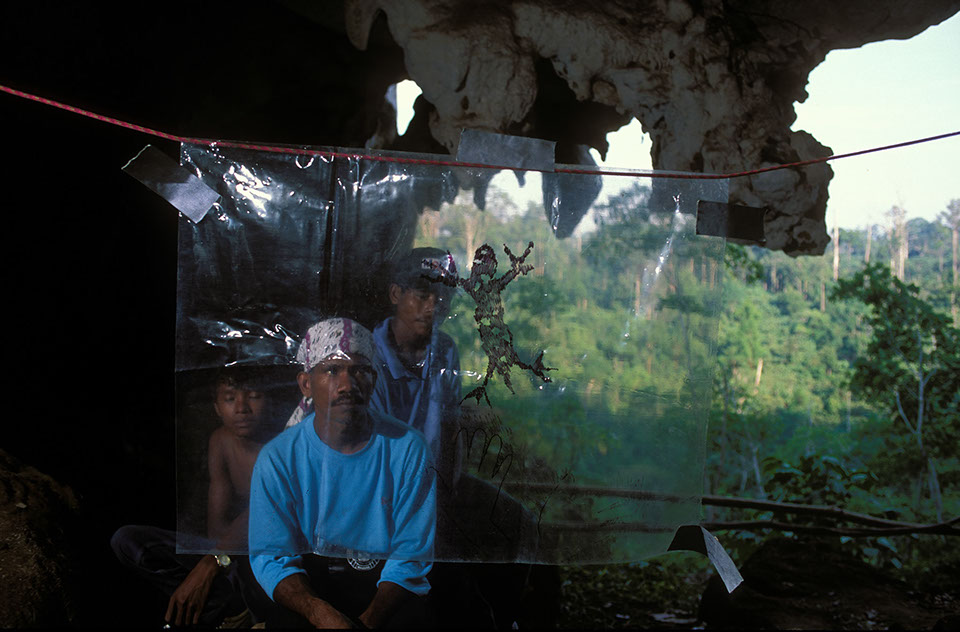
Guides puzzled by overhead transparencies of flying lizards and negative hands...
Group 7: an isolated hand, 2 m from the ground. Not photographed.
Group 8: arachnoid drawing, in fact one or two masked anthropomorphs.
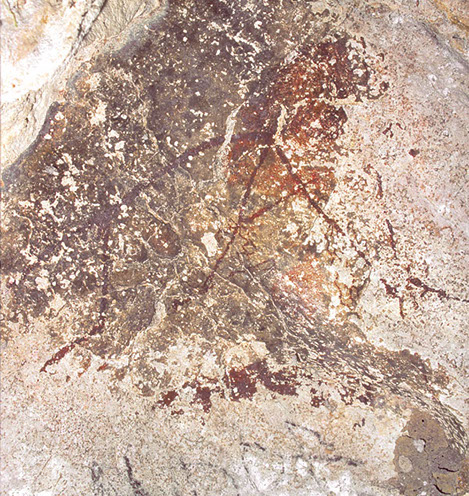
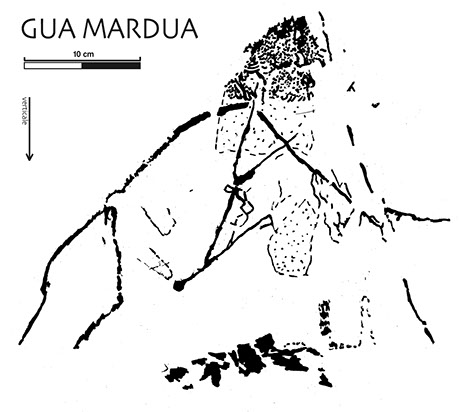
Figure 16 - The capped anthropomorph (group 7), in trance?
Group 9: in the dome, far above the paintings, on the opposite side (in the shade), remains of negative hands, around 10, in a very degraded state.
Group 10: in the east gallery, a few survivors of erosion: 3 negative hands, a curious shape probably an animal without legs, a strange rectangular drawing and a round one (fingerless hand?).
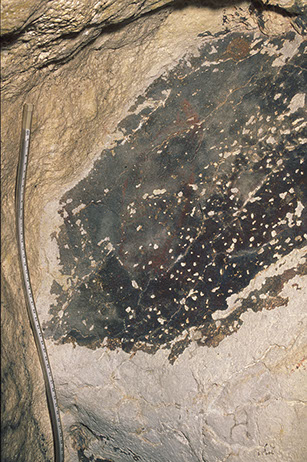
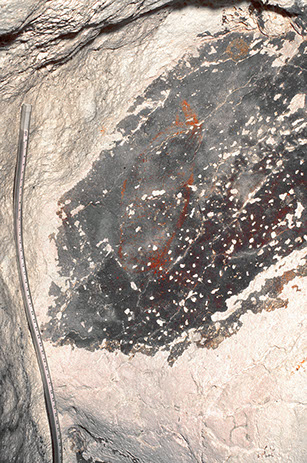
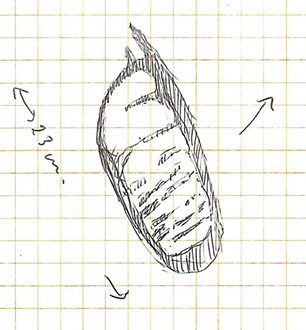
Figure 17 and photo: the strange shape of group 10.
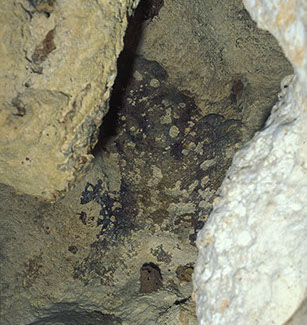
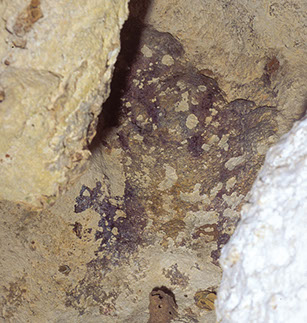
Photo 5: a negative hand in a recess of a stalagmitic massif.
Statistics
• Total: 49 negative hands.
Left/Right distribution: 11 right hands, 17 left hands, 21 undetermined. 12 overloaded hands.
• Total paintings: 8
• Total charcoal drawings: 24